


كيف يعمل مقياس الضغط المصغر؟ شرح تقني
Release time: 2026-04-07
Mini pressure gauges are compact pressure measurement instruments widely used in industrial systems where installation space is limited but accuracy and reliability are still required.
Despite their small size, they operate on the same mechanical principles as standard pressure gauges and are commonly used in pneumatic systems, hydraulic equipment, and compressors.
This article explains the working principle, internal structure, and industrial applications of mini pressure gauges in a clear technical way.
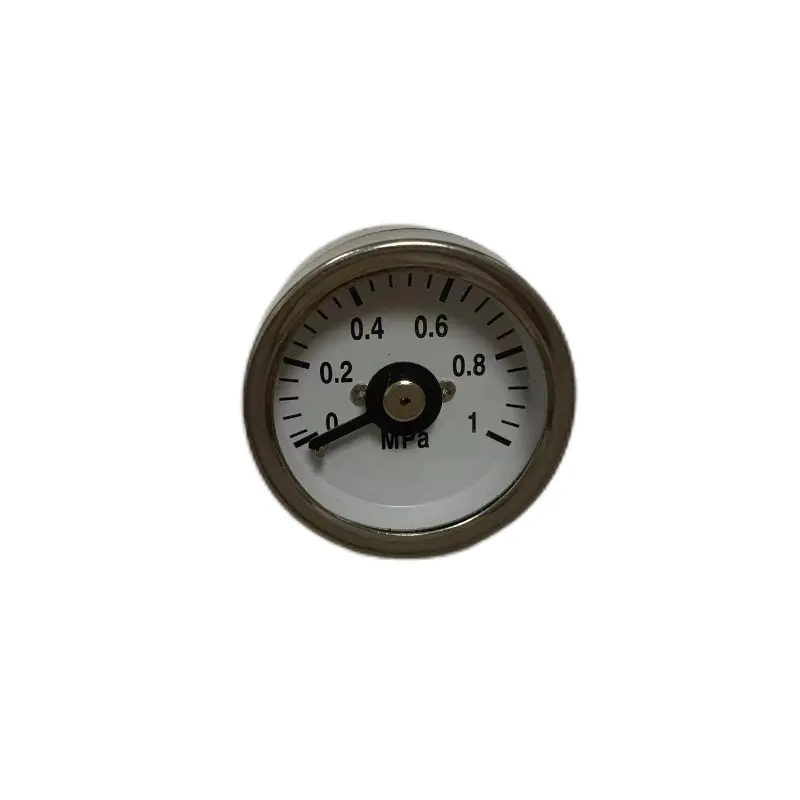
1. Working Principle of a Mini Pressure Gauge
Most mechanical mini pressure gauges operate based on the Bourdon tube mechanism, a proven technology used in pressure measurement for over a century.
Step 1: Pressure Entry
When fluid or gas enters the pressure port, it flows into a curved Bourdon tube inside the gauge.
Step 2: Elastic Deformation
As internal pressure increases, the Bourdon tube tends to straighten due to elastic stress. This deformation is proportional to the applied pressure level.
Step 3: Mechanical Transmission
The small movement of the tube is transferred through a mechanical linkage system, which typically includes gears and levers that amplify the motion.
Step 4: Pointer Display
The amplified movement rotates a pointer across a calibrated dial, converting mechanical motion into a readable pressure value.
Step 5: Pressure Release
When pressure decreases, the Bourdon tube returns to its original shape, and the pointer moves back accordingly.
This simple mechanical process allows mini pressure gauges to provide real-time, power-free pressure monitoring.
2. Internal Structure of a Mini Pressure Gauge
Although compact in size, mini pressure gauges consist of several precision components:
- Bourdon tube: The sensing element that reacts to pressure changes
- Movement mechanism: Converts tube deformation into pointer rotation
- Dial face: Displays calibrated pressure units such as bar, psi, or kPa
- Pointer needle: Indicates real-time pressure readings
- Housing case: Protects internal parts from vibration and environmental impact
Depending on application requirements, housing materials may vary to improve corrosion resistance, durability, or weight reduction.
3. Mini Pressure Gauge vs Standard Pressure Gauge
While both types measure pressure using similar principles, mini pressure gauges are optimized for compact system integration.
- Size: Mini gauges are significantly smaller and suitable for tight installations
- Installation flexibility: Can be mounted in confined spaces or embedded systems
- Application focus: More commonly used in compact machinery
- Design purpose: Focused on space efficiency without sacrificing accuracy
Standard gauges are typically used in large industrial setups where space constraints are not a concern.
4. Applications of Mini Pressure Gauges
Mininature pressure gauges are widely used across multiple industries due to their compact design and reliability:
Pneumatic Systems
Used to monitor air pressure in compressors, automation lines, and control systems.
Hydraulic Systems
Essential for monitoring oil pressure in compact hydraulic machinery and equipment.
الأتمتة الصناعية
Integrated into control panels for real-time pressure feedback.
أنظمة التدفئة والتهوية وتكييف الهواء
Used in air conditioning and refrigeration systems to ensure stable operating pressure.
General Industrial Equipment
Applied in a wide range of machinery where space-saving instrumentation is required.
5. Advantages of Mini Pressure Gauges
Mini pressure gauges are increasingly popular in modern industrial design due to several advantages:
- Compact size for space-limited installations
- No external power required
- Almost unaffected by shocks and vibrations
- Cost-effective solution for mass production equipment
These benefits make them ideal for modern automated and modular industrial systems.
6. Selection Considerations
When choosing a mini pressure gauge, engineers typically consider:
- Pressure range requirements
- Media type (gas, air, oil, etc.)
- Installation method (back entry or bottom connection)
- Housing material and durability
- Environmental conditions such as vibration or corrosion
Proper selection ensures long-term stability and measurement accuracy.
7. Conclusion
Mini pressure gauges operate using a simple yet highly reliable mechanical principle based on Bourdon tube deformation and mechanical amplification. Their compact structure makes them ideal for modern industrial systems that require precise pressure monitoring in limited installation space.
As industrial equipment continues to become more compact and automated, mini pressure gauges remain an essential component in ensuring system safety and operational stability.
Explore our full range of mini pressure gauge solutions for industrial on our product category page.

